
Welcome my dear wire wrapper!
Do you admire the shimmering light that abalone shell and crystals give off? I’ve designed a pendant that captures just that!
Let’s learn how to wire wrap a necklace pendant with copper wires, abalone shell and crystal.
In my Wire-Wrapping Rustic Round Abalone Shell Coiled Coil Pendant Tutorial, you will master techniques such as double coiling and wire structuring.
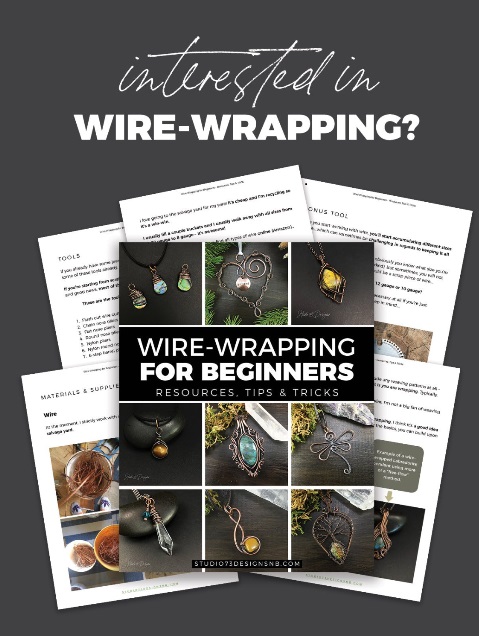
FREE WIRE-WRAPPING GUIDE TO YOUR EMAIL!
JOIN NEWSLETTER
We respect your privacy. Unsubscribe at anytime.
Start your wire jewelry making journey today with my simple step-by-step instructions and detailed progress pictures.
Happy wrapping!

LEVEL: INTERMEDIATE
MATERIALS + TOOL
- Copper Wire (18 AWG)
- Copper Wire (20 AWG)
- Copper Wire (22 AWG)
- Copper Wire (26 AWG)
- Abalone Cabochon Round Shells (1 pc)
- Small Raindrop Crystal with Hole (1 pc)
- Wire Cutter
- Chain Nose Pliers
- Round Nose Pliers
- Nylon Jaw Pliers
- Stepped Bail-Making Pliers
- Finest Steel Wire Wool
- Masking Tape

Prefer this wire-wrapping tutorial in a PRINTABLE FORMAT? (High Resolution Photos)
WIRE-WRAPPING RUSTIC ROUND ABALONE SHELL COILED COIL PENDANT TUTORIAL
Step 1 of 10
Ready all items from the Materials and Tool list (fig. 1a).
Let’s form the main frame for your round abalone shell using an 18-gauge copper wire (fig. 1b, 1c).
Loop the wire around your abalone shell and tape it in place (fig. 1d, 1e).
Then, bend the extra 18-gauge copper wires into straight lines with a chain nose pliers (fig. 1f, 1g, 1h, 1i).


Step 2 of 10
Next, hammer the 18-gauge main frame flat on a base metal plate (fig. 2a, 2b, 2c, 2d).
Crisscross the extra flat wire frame at the top and hammer the extra 18-gauge straight copper wires flat (fig. 2e, 2f).
Then, form a double wire bail by curling the flatten straight wires with a stepped bail-making pliers (fig. 2g, 2h, 2i, 2j).


Step 3 of 10
Moving on, let’s add a layer of coiled coil or double coiled wire onto your pendant frame.
Take a 22-gauge copper wire as the inner wire and a 26-gauge copper wire as the coiling wire to form a coiled wire (fig. 3a, 3b).
Note: Use a coiling gizmo to speed up the coiling process.
Bundle the coiled wire and a new string of 22-gauge copper wire on a tape, and then coil the wire ends together (fig. 3c, 3d, 3e).
After that, take a 20-gauge copper wire, and manually twist a thick double coiling effect with the wire bundle (fig. 3f, 3g, 3h)
Checkpoint: This is how your coiled coil wire design should look (fig. 3i).


